Tool
Dental & vision comparison tool.
Compare three dental or vision plans across all four coverage tiers without an account. Enter rates, enrollment, contributions and benefit terms; calculate employee costs and download a CSV. Check benefits and networks against the carrier documents.
Free interactive comparison
Edit the plans. Compare all four tiers.
A synthetic example is loaded. Type rates and benefit terms from the quotes you want to compare. This worksheet calculates premiums, contributions and deductions locally; it does not parse PDFs, verify networks or upload your entries.
Edit all three plans, enrollment and tier contributions
Employee only
Employee + spouse
Employee + children
Family
| Coverage tier | Current | Renewal | Proposed |
|---|---|---|---|
| Employee only | $20.00 | $22.00 | $21.00 |
| Employee + spouse | $40.00 | $44.00 | $42.00 |
| Employee + children | $44.00 | $48.40 | $46.20 |
| Family | $70.00 | $77.00 | $73.50 |
| Annual group premium | $4,368.00 | $4,804.80 | $4,586.40 |
| Coverage tier | Current | Renewal | Proposed |
|---|---|---|---|
| Employee only | $2.50 | $2.75 | $2.63 |
| Employee + spouse | $5.00 | $5.50 | $5.25 |
| Employee + children | $5.50 | $6.05 | $5.78 |
| Family | $8.75 | $9.63 | $9.19 |
| Employer annual share | $3,276.00 | $3,603.60 | $3,439.80 |
Group totals use the same enrollment for each option. Proposed costs $218.40 more per year than Current. Compare the benefit terms and provider access alongside cost.
Edit and compare the benefit terms
| Benefit | Current | Renewal | Proposed |
|---|---|---|---|
| Plan type | |||
| Annual maximum | |||
| Individual deductible | |||
| Family deductible | |||
| Preventive | |||
| Basic services | |||
| Major services | |||
| Orthodontia | |||
| Waiting period |
No email or account is required. Values remain in this page’s memory and the CSV you choose to download. Reloading clears edits.
What a quoting platform should include for dental and vision plans
A quoting platform should include, for dental: plan type (PPO, DHMO or indemnity), annual maximum, deductible, the preventive, basic and major coinsurance levels, orthodontia coverage and lifetime maximum, waiting periods, and in-network versus out-of-network reimbursement. For vision: exam copay and frequency, frames and contact lens allowances, lens copays, lens frequency, and the discount schedule. It should also hold rates by the same coverage tiers as the medical plan, bundled or standalone, so the three lines can be compared and presented together.
The two tables below are that field list, with the typical range for each. Planlined reads these fields out of carrier dental and vision proposals alongside the medical quotes, so the side-by-side comparison and the proposal book carry all three lines on the same tiers. Review the extracted values against the carrier documents before they go to a client.
To lay the plans out by hand instead, the free benefit comparison template covers medical, dental, vision, life and disability in one file.
See the completed result
See the costs in a completed dental renewal.
Compare current and renewal premiums, check employer and employee shares, and inspect the Excel financial comparison. Final settings were saved and confirmed after reopening.
- Current → renewal per month
- $590 → $649
- Employer contribution
- 80%
- Employee-only per paycheck · 24 deductions
- $3.30
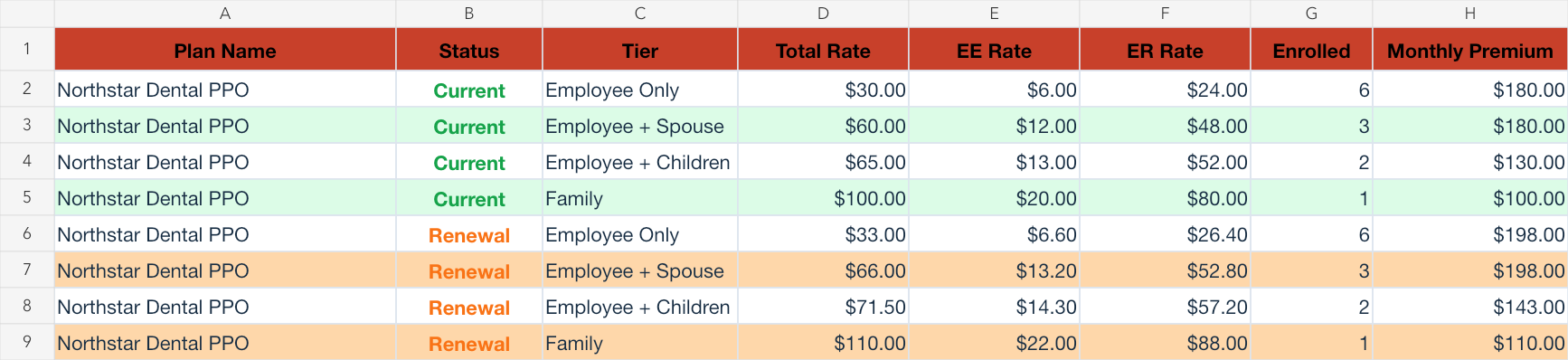
Fictional dental example. Rates and enrollment were entered manually and contribution settings were reviewed. All eight financial rows in the Excel export match the inputs; paycheck costs were checked separately in the application and by calculation.
Dental plan comparison
| Feature | Description | Example plan design |
|---|---|---|
| Annual Maximum | Max the plan pays per year | $1,000 - $2,500 |
| Deductible | Amount before coverage starts | $25 - $100 individual |
| Preventive Care | Cleanings, exams, x-rays | 100% (no deductible) |
| Basic Services | Fillings, extractions | 70-80% after deductible |
| Major Services | Crowns, bridges, dentures | 50% after deductible |
| Orthodontia | Braces, aligners | 50% up to $1,500 lifetime |
| Waiting Periods | Time before coverage starts | 0-12 months for major |
Dental plan types
Dental PPO
- +Freedom to see any dentist
- +No referrals needed
- +Out-of-network coverage available
- +Large networks
- -Higher premiums
- -Higher out-of-pocket if out-of-network
- -Annual maximums apply
Dental HMO (DHMO)
- +Lower premiums
- +No annual maximum
- +No deductibles typically
- +Predictable copays
- -Must use assigned dentist
- -Smaller networks
- -Referrals for specialists
- -Geographic limitations
Dental Indemnity
- +Any dentist, anywhere
- +No network restrictions
- +Simple reimbursement
- -Highest premiums
- -Upfront payment required
- -UCR limitations may apply
Vision plan comparison
| Feature | Description | Example plan design |
|---|---|---|
| Exam Coverage | Annual eye exam | $10-20 copay or 100% |
| Exam Frequency | How often covered | Every 12 months |
| Frames Allowance | Amount toward frames | $100 - $200 |
| Lenses Coverage | Single, bifocal, progressive | $25 copay or 100% |
| Contact Lens Allowance | Amount toward contacts | $100 - $200 |
| Lens Frequency | How often lenses covered | Every 12-24 months |
| Discounts | Additional savings | 20-40% off additional pairs |
How many workers can get these benefits
Source: U.S. Bureau of Labor Statistics, National Compensation Survey, March 2025, private industry workers, retrieved from the BLS Public Data API on September 15, 2026. Vision is offered far less often than medical or dental, which is why it can set a package apart.
Bundling strategies
Bundle with medical
- ●Many carriers offer discounts for bundling
- ●Single billing and administration
- ●Coordinated ID cards and portals
- ●Ask each carrier whether a multi-line discount applies
Carve-out strategy
- ●Best-in-class specialty carriers
- ●Larger networks for dental/vision
- ●More competitive standalone pricing
- ●Flexibility at renewal to shop separately
Whichever route you take, dental and vision are usually decided together with life, disability and voluntary lines. The ancillary benefits strategy guide covers how to package them.
Before presenting, show what each option costs an employee per paycheck: the payroll deduction calculator turns a monthly rate and employer contribution into a per-pay-period amount. After the plans are in force, check the monthly dental and vision bills against enrollment, as described in the benefits invoice reconciliation guide.
Compare all benefit types in one place.
Planlined handles medical, dental, vision, life, and disability comparisons—all in a single, unified platform.
Frequently asked questions
What should a quoting platform include for dental and vision plans?
A quoting platform should include, for dental: plan type (PPO, DHMO or indemnity), annual maximum, deductible, the preventive, basic and major coinsurance levels, orthodontia coverage and lifetime maximum, waiting periods, and in-network versus out-of-network reimbursement. For vision: exam copay and frequency, frames and contact lens allowances, lens copays, lens frequency, and the discount schedule. It should also hold rates by the same coverage tiers as the medical plan, bundled or standalone, so the three lines can be compared and presented together.
What is the difference between dental PPO and DHMO?
PPO plans offer more provider choice with in-network discounts but higher premiums. DHMO plans require choosing a primary dentist, have lower premiums, but limited networks. PPO is better for flexibility, DHMO for cost savings.
What should I compare in dental plans?
Key comparison points: Annual maximum (example plan designs run $1,000-$2,500), deductibles (individual/family), coverage percentages (preventive/basic/major), orthodontia coverage, waiting periods, and network size in your area.
Are vision plans worth offering?
Vision plans are low-cost, high-value benefits. As an example plan design, a vision plan might cost $5-15/month and provide significant savings on exams, glasses, and contacts.