Feature
Rate Negotiation Analysis
Rate negotiation analysis tools for benefits brokers should turn a renewal into a costed counter-offer: the agreed baseline, each alternative, and what it means for the employer and for every paycheck. Planlined builds that analysis from one reviewed case; the broker does the negotiating.
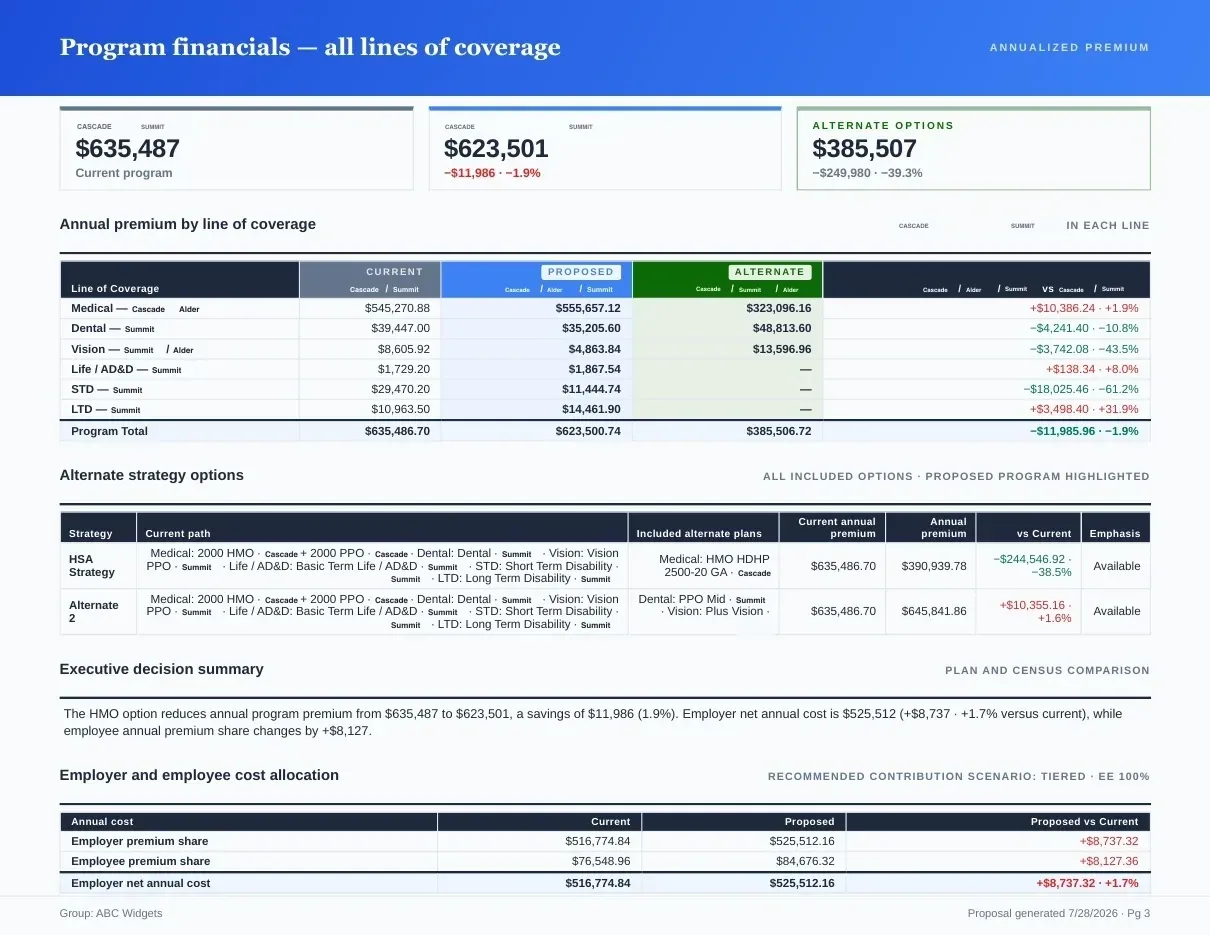
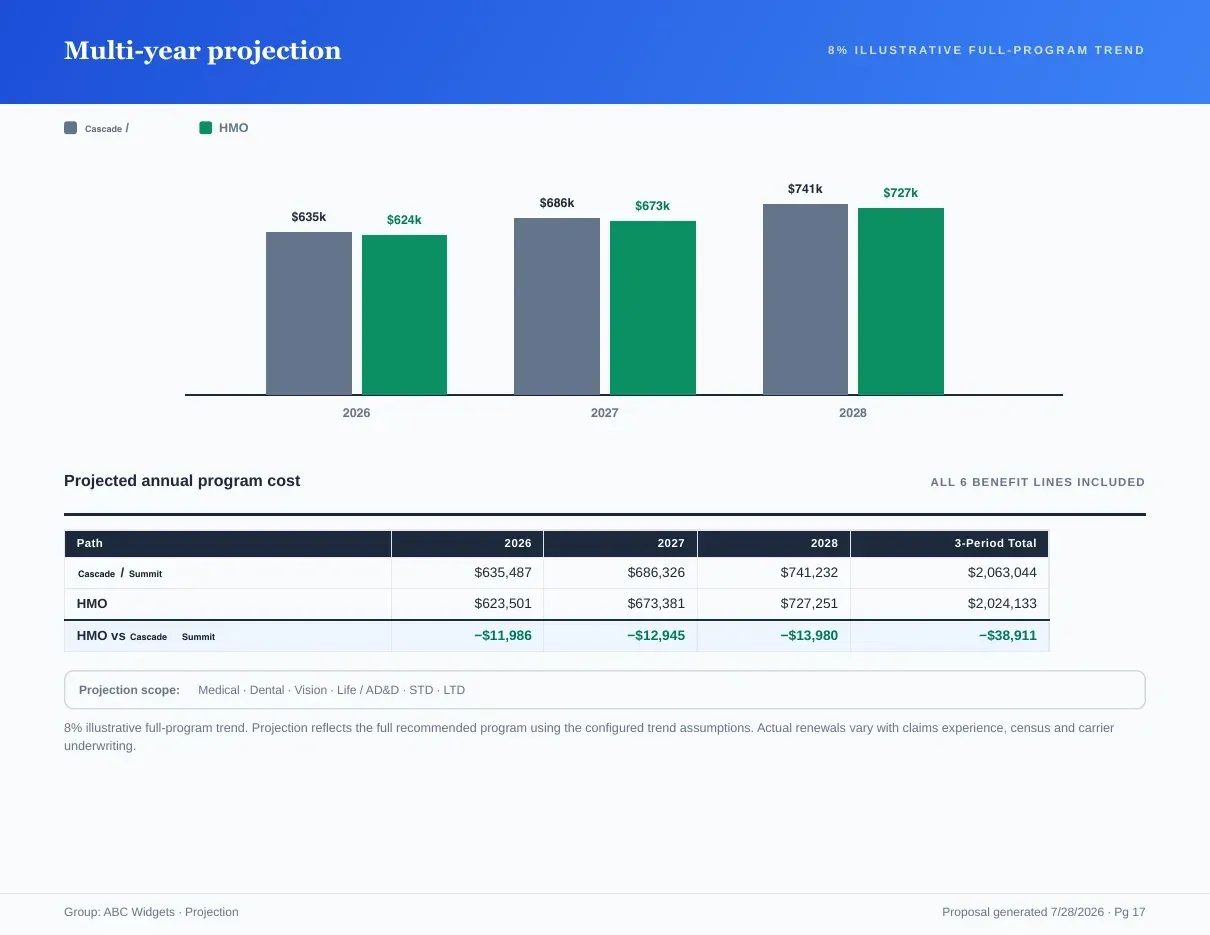
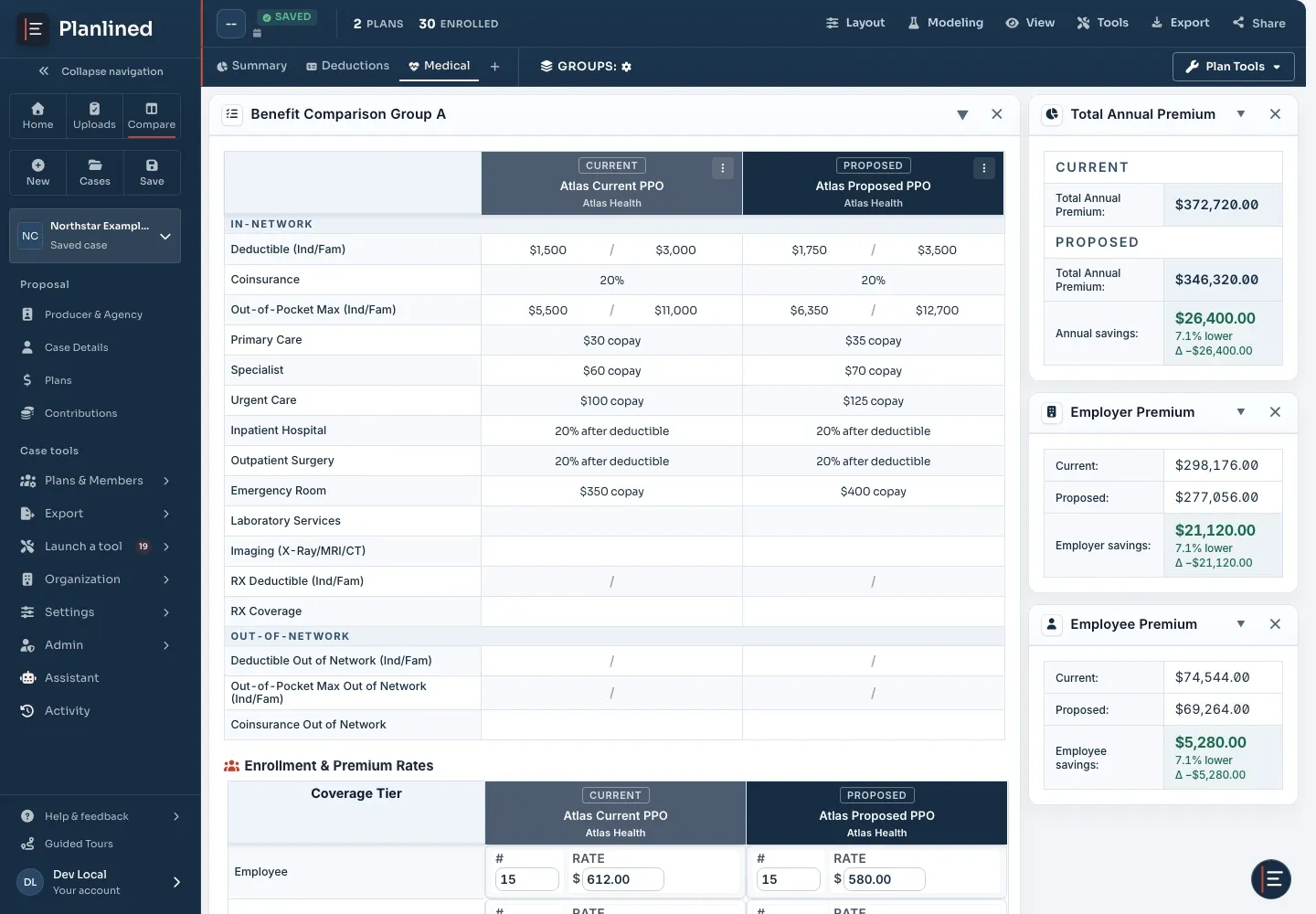
Page 1 of 3Every line of coverage, current against proposed and alternate.
What you get
Why Rate Negotiation Analysis?
- Current vs Renewal BaselineStart from side-by-side current and proposed rates so everyone agrees on the real baseline before strategy discussions.
- Scenario-Backed Counter OptionsModel contribution and plan alternatives to show what changes the economics for both employer and employees.
- Benchmark ContextLayer in the benchmark references your team has to frame the renewal; Planlined is not an independent benchmark database.
- Projection VisibilityShow multi-period cost direction so the discussion is about trajectory, not only this cycle.
- Proposal-Ready NarrativeTurn negotiation talking points into a client-facing recommendation with supporting exhibits.
- Single Source of TruthKeep quotes, assumptions, and outputs tied to one case so negotiations and client delivery stay consistent.
Planlined prepares the negotiation case. It does not negotiate with the carrier.
A defensible rate discussion starts with agreed current and renewal numbers, then separates plan changes, enrollment changes, contribution choices, and projected cost. Planlined keeps that comparison and the alternative scenarios in one case so the broker can take a documented counter-position to the carrier and a clear recommendation to the client.
Fictional worked example
A 10% renewal, a counter-offer and an alternative, costed.
Ten contracts stay enrolled: five employee-only, two employee-plus-spouse, one employee-plus-children and two family. The employer pays 75% of every tier, and employees are paid 26 times a year. The incumbent's renewal is 10% higher in every tier.
| Position | Monthly premium | Annual premium | Change vs current | Employer, annual (75%) | Employee-only, per paycheck |
|---|---|---|---|---|---|
| Current plan year | $8,200 | $98,400 | — | $73,800 | $57.69 |
| A · Renewal offered (+10%) | $9,020 | $108,240 | +10% | $81,180 | $63.46 |
| B · Counter-position (+6%) | $8,692 | $104,304 | +6% | $78,228 | $61.15 |
| C · Alternate, higher deductible (+3%) | $8,446 | $101,352 | +3% | $76,014 | $59.42 |
Download the fictional renewal and invoice workbook (Excel, 10 KB). Change the illustrative inputs and inspect the formulas; it is not a Planlined export.
Check the math
Counter B applies +6% to each current rate: $530, $1,060, $954 and $1,484. Monthly premium is (5 × $530) + (2 × $1,060) + (1 × $954) + (2 × $1,484) = $8,692, or $104,304 a year. Alternate C applies +3%: $515, $1,030, $927 and $1,442, for $8,446 a month. Employee-only cost per paycheck is the rate × 25% × 12 ÷ 26, so $530 becomes $61.15.
What the counter is worth
Against the renewal as offered, counter B is worth $3,936 a year: $2,952 to the employer and $984 to employees together. Alternate C is worth $6,888 ($5,166 and $1,722), but it is not like for like: it raises the deductible, so the client is trading premium for out-of-pocket exposure. In this invented example, C illustrates a plan-design tradeoff. A real carrier conversation needs an actual competing quote and its benefit terms; the hypothetical rate is not evidence of a market offer.
The counter still needs reasons the broker brings: the group's claims experience, competing quotes and any benchmark context the team trusts. If the carrier owes a rebate, the MLR rebate calculator shows how to size it; for level-funded groups, the level-funded renewal guide covers the numbers to compute first. Check any contribution assumption per paycheck with the payroll deduction calculator.
In Planlined, the current, renewal, counter and alternate rates sit in one case as plans marked current, renewal, proposed or alternate. Scenarios compare annual total, employer and employee cost against the baseline on the same enrollment and contribution rule, so the comparison and the proposal exhibits come from the same numbers. Planlined is not a quoting engine: the counter and alternate rates are the ones the broker enters or imports.
The same four positions, costed by the app
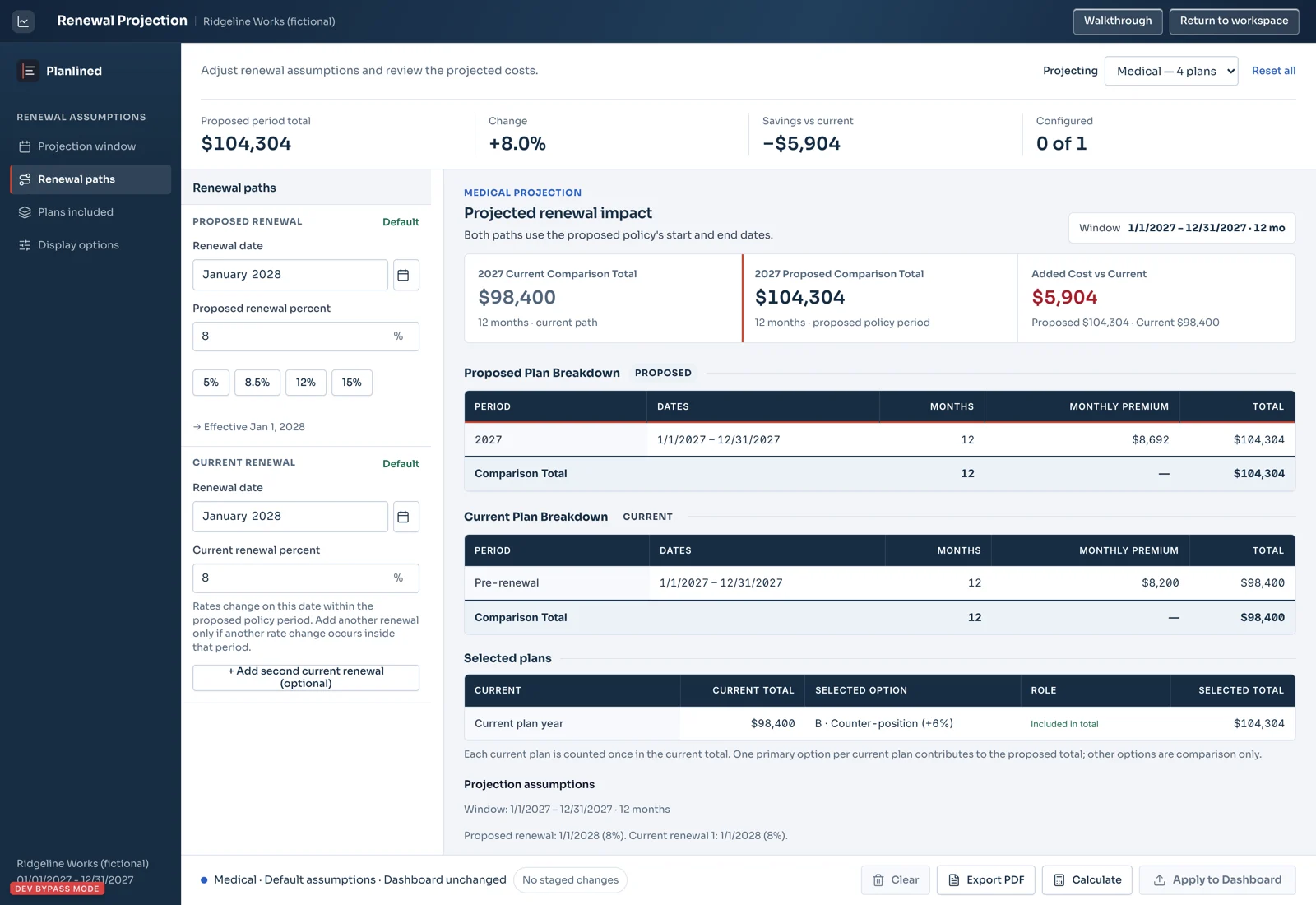
Planlined has no separate counter-offer tool: each position is a plan in the case, with its own role. We gave the app a fictional case holding the current plan, the +10% renewal, the +6% counter-position and the +3% alternate on the same ten contracts, with a 75% employer share and 26 pay periods, and read what its contribution and renewal-projection views calculated.
| Position | Employer / month | Employee only / month |
|---|---|---|
| Current plan year | $6,150.00 | $125.00 |
| A · Renewal offered (+10%) | $6,765.00 | $137.50 |
| B · Counter-position (+6%) | $6,519.00 | $132.50 |
| C · Alternate, higher deductible (+3%) | $6,334.50 | $128.75 |
Every figure matches the hand arithmetic above. For the renewal, the app also showed $81,180 a year from the employer and $1,040.77 in total employee deductions per pay period. The renewal projection showed the counter-position at $104,304 a year against $98,400, or $5,904 more. These two views did not show a per-employee paycheck figure, and the projection's header read +8.0%, its default assumption for a 2028 renewal, rather than the 6% between the two totals.
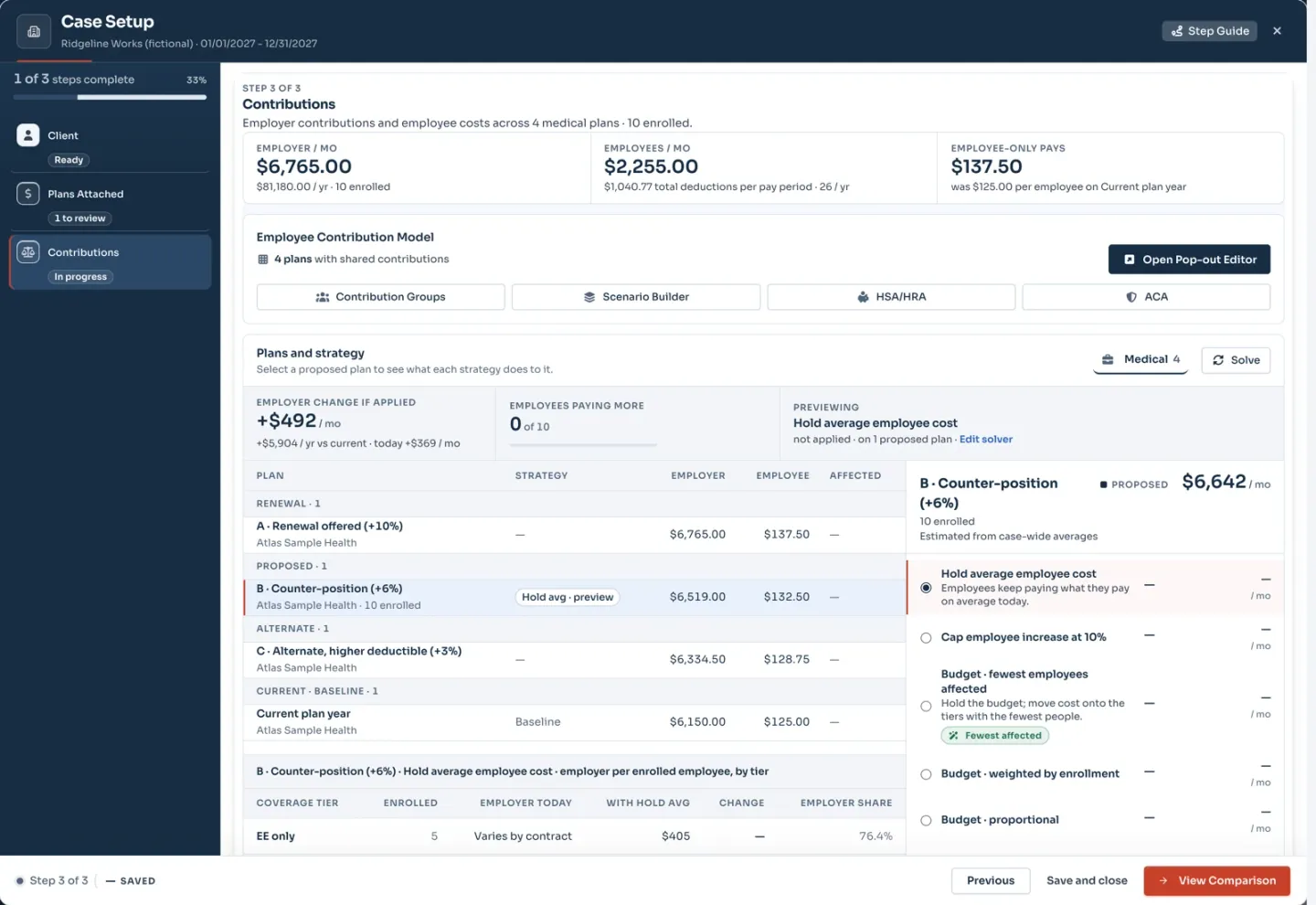
The case was supplied to the app's own pages in place of a saved case, on a local development build rather than the production release, with every save blocked; nothing was saved or exported. Inspect the fictional case record, the renewal projection screen and the dated check record.
What you can verify before trying it
Before recommending a position, hold enrollment and contribution assumptions constant, then identify any benefit or network changes separately. An illustrated counter-offer is a modeling assumption until the carrier confirms the rates and effective date.
The dated sample proposal and verification method provides a fictional source PDF, expected values and a six-page application export. On October 20 the app extracted both plans and all eight monthly rates from that PDF; plan roles and contribution settings were set manually, and source-location linking remains unverified. An earlier October 16 attempt failed to import, so that case was entered manually, saved and reopened; the page documents both runs. Neither verifies automated invoice reconciliation or an accepted carrier counter-offer.
Inspect the October 20 sample proposal PDF, or use the editable workbook above to check the illustrative arithmetic. The workbook and this page's worked example were assembled separately from the application.
Rate Strategy Playbook
Rate negotiation analysis questions
What are rate negotiation analysis tools for benefits brokers?
They turn a renewal into numbers a broker can negotiate with: the agreed current and renewal baseline, the cost of each counter-position and alternative, and what each one means for the employer and for an employee's paycheck. Some tools add claims analytics or market benchmarks. Planlined builds the comparison, scenarios and exhibits from one reviewed case; it does not supply benchmarks or negotiate for the broker.
Does Planlined negotiate with carriers?
No. The broker negotiates. Planlined prepares the comparison, scenarios, projections, and exhibits that support the conversation.
What belongs in the analysis?
Use current and renewal rates, plan and enrollment changes, employer and employee cost impact, credible alternatives, and the assumptions behind the recommendation.
Does Planlined supply market benchmarks?
It can organize benchmark context your team brings to the case. It is not an independent carrier-rate database or actuarial benchmarking service.
Prepare a group health renewal counteroffer for source checks, a fictional example and review limits.
Continue the review
Read the carrier packet before comparing the renewal.
Use the carrier-specific guide for the documents in front of you. KFF describes market context; MLR rebates describe past insurer experience. Neither is a quote for this employer.
Run your next renewal through Planlined.
Upload the carrier packet. Walk out with the comparison, the proposal book and the employee guide.