Alternatives to Excel for Benefit Proposals: A Broker Guide
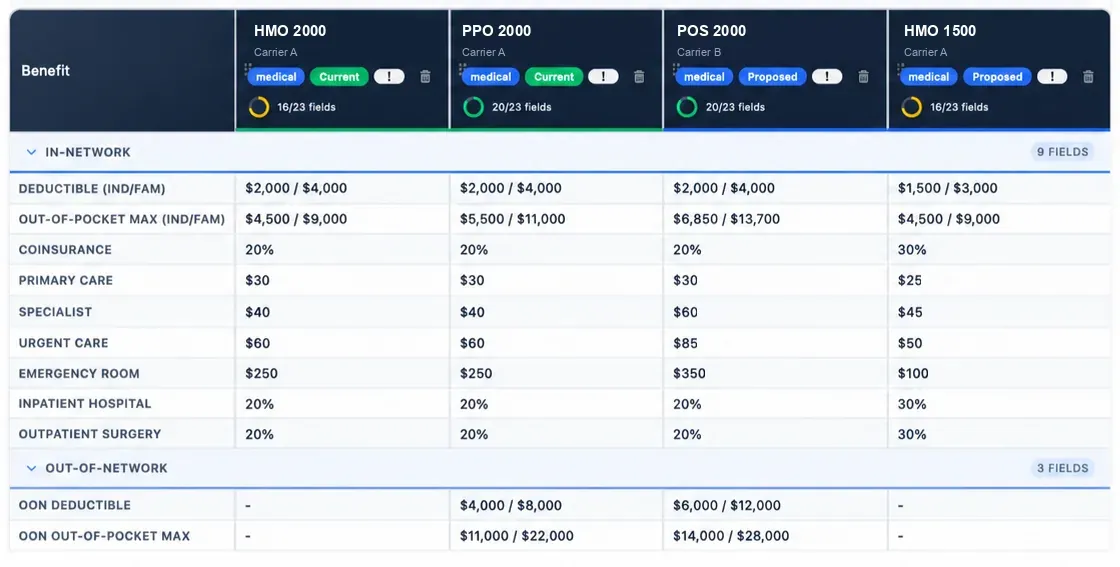
The best Excel alternative depends on where the work starts. A template is enough for occasional proposals; a database helps teams share structured data; a generic proposal builder improves presentation; and document-first benefits software such as Planlined handles carrier-file intake, source review, contribution modeling, and client output together.
| Alternative | Best fit | Main tradeoff |
|---|---|---|
| Controlled Excel or Sheets template | Occasional proposals and unusual calculations | Manual source entry and formula ownership remain |
| Airtable or database workspace | Shared plan libraries and team workflow | Benefits logic and client output must be built |
| Generic proposal software | Design, approvals, and signatures | Does not normally interpret SBCs or rate tiers |
| Carrier-rate quoting platform | Quoting from a connected rates database | May not match emailed PDF and spreadsheet workflows |
| Document-first benefits software | Recurring carrier PDFs, comparisons, and proposals | Requires source review and a product workflow |
The Excel Era: Why Spreadsheets Became the Standard
For years, Excel was the only practical option for creating benefit comparisons. It offered:
- Complete control over layout and formatting
- Flexibility to handle any data structure
- No additional software costs (most offices already had Excel)
- Familiarity—everyone knows how to use Excel
But as benefit plans have become more complex and client expectations have increased, the limitations of Excel are becoming harder to ignore.
The Hidden Costs of Excel
While Excel itself is inexpensive, the time costs add up quickly:
1. Manual Data Entry
Every carrier PDF or rate sheet requires manual typing. For a proposal with 3 carriers and 4 plan types each, that's potentially 50+ data points to enter by hand.
2. Formula Maintenance
Contribution calculations, census aggregations, and cost comparisons all require complex formulas. One wrong cell reference and your entire proposal could be incorrect.
3. Formatting and Cleanup
Making proposals look professional in Excel is tedious. Adjusting column widths, setting up print areas, and ensuring everything fits on the page takes significant time.
4. Error Checking
With manual entry and complex formulas, you need to carefully verify every number. The stakes are high—errors can cost clients thousands of dollars.
5. Revisions
When clients request changes, you often need to rebuild sections of your spreadsheet or carefully update formulas without breaking things.
Total Time Investment
The manual workload can be substantial, especially when source files, formulas, and revisions live in separate spreadsheets.
Modern Benefit Comparison Software: The Automation Alternative
Purpose-built software addresses Excel's limitations with automation and intelligent features:
Automated Data Extraction
Planlined brings carrier PDFs and Excel files into one reviewable case, where plan details can be checked alongside their source material.
- Upload carrier rate sheets → Data extracted automatically
- Upload SBC documents → Review plan data with the source files
- Upload census files → Employee data imported
Built-In Calculation Logic
Pre-built calculation engines handle contribution modeling, cost projections, and census aggregations automatically.
- No formulas to write or maintain
- Instant recalculation when you change any number
- Built-in validation to catch potential errors
Professional Templates
Co-branded proposal templates eliminate formatting work:
- Add your logo and colors once
- Consistent professional output every time
- Export as interactive HTML or branded PDF
Rapid Revisions
Develop a revised recommendation without rebuilding disconnected spreadsheets:
- Copy existing scenarios with one click
- Real-time updates across all sections
- Version history for reference
Time with Automation Software
The value of an automated workflow is a clear, reviewable case and less repeated formatting work—not a promised fixed completion time.
Head-to-Head Comparison
| Feature | Excel | Comparison Software |
|---|---|---|
| Data Entry | Manual transcription from source files | Automated extraction followed by source review |
| Calculations | Manual formulas | Built-in engines |
| Error Risk | Depends on entry, formulas, and review controls | Uncertain extracted values remain reviewable |
| Formatting | Manual layout and print-area maintenance | Generated proposal templates |
| Revisions | Update cells, formulas, and presentation separately | Update the reviewed case and regenerate output |
| Learning Curve | Minimal (familiar) | Product-specific intake and review workflow |
| Cost | Usually part of an existing office suite | Planlined: first proposal free, then $75/month |
| Total Time | Manual entry, formula work, and formatting | Varies by case and source review |
When Does Software Pay for Itself?
Measure your own workflow instead of borrowing a universal time-savings percentage. For one normal case, record the time spent transcribing source files, checking formulas, formatting the client output, and making revisions. Compare that with the same case in the software, including source review. Multiply the difference by monthly proposal volume and loaded hourly cost, then subtract the subscription price.
The Planlined ROI calculator keeps those assumptions visible so you can decide from your own volume rather than a marketing benchmark.
When Excel Still Makes Sense
To be fair, there are scenarios where Excel remains the better choice:
- You only create 1-2 proposals per year
- You have extremely custom formatting requirements
- You need to analyze data in ways standard software doesn't support
- Budget constraints make any monthly cost prohibitive
Making the Transition
If you decide to try automation software — dedicated benefit comparison software for brokers, or the SBC comparison tool when your inputs are SBC PDFs — here's how to make the switch smooth:
- Start with one proposal: Most tools offer a free first proposal. Test it on a real client project.
- Compare side-by-side: Create the same proposal in Excel and the software. See the time difference yourself.
- Keep Excel as backup: For the first month, keep your Excel templates available. You'll quickly find you don't need them.
- Train your team: If you have multiple people creating proposals, schedule a training session together.
Try Both Approaches Risk-Free
Download our free Excel template OR try Planlined's automated software. See which approach works better for your workflow.
Conclusion: The Right Tool for the Right Job
Excel is a powerful, flexible tool that will always have a place in benefit analysis. But for repetitive proposal creation, automation software offers clear advantages:
- A shared, reviewable workflow for routine proposals
- Source-linked review instead of hidden transcription
- Professional, consistent output
- A measurable workflow change you can test on a real case
Use Excel when flexibility matters more than repeatability. Use document-first benefits software when the same carrier-file, review, modeling, and client-delivery work repeats often enough that one connected case is easier to maintain than several spreadsheets.
Frequently asked questions
What is the best alternative to Excel for benefit proposals?
For recurring carrier-PDF workflows, use document-first benefits software that keeps extraction, source review, contribution modeling, and client output in one case. For occasional proposals, a controlled spreadsheet template may still be the better fit.
Can a generic proposal tool replace a benefits comparison spreadsheet?
A generic proposal tool can improve layout and signatures, but it usually does not normalize SBC fields, carrier rate tiers, or employer and employee contribution calculations. It works best after the benefits analysis is complete.
Can Planlined export data back to Excel?
Planlined supports workbook output for teams that need an editable spreadsheet after the reviewed case and proposal have been prepared.