Fictional worked example
From a Claude conversation to a checked proposal PDF.
A fictional two-plan source packet became a saved Planlined case through Claude. The case was checked against the original source, the review limitations were added to the proposal, and Planlined generated the seven-page PDF you can inspect below.
What this example demonstrates
Checked November 4, 2026 through native Claude and the production Planlined application. The demonstrated scope is an authorized two-plan case transfer, saved financial values, explicit source review and an actual PDF export from Planlined.
Swipe or scroll sideways to read the full results table.
| Workflow | Evidence status | Observed result |
|---|---|---|
| Claude connector case creation | Demonstrated | An authorized Claude conversation created one new Planlined case with two medical plans. The full Current/Renewal names, roles, eight tier rates and enrollment counts were present in the saved case. |
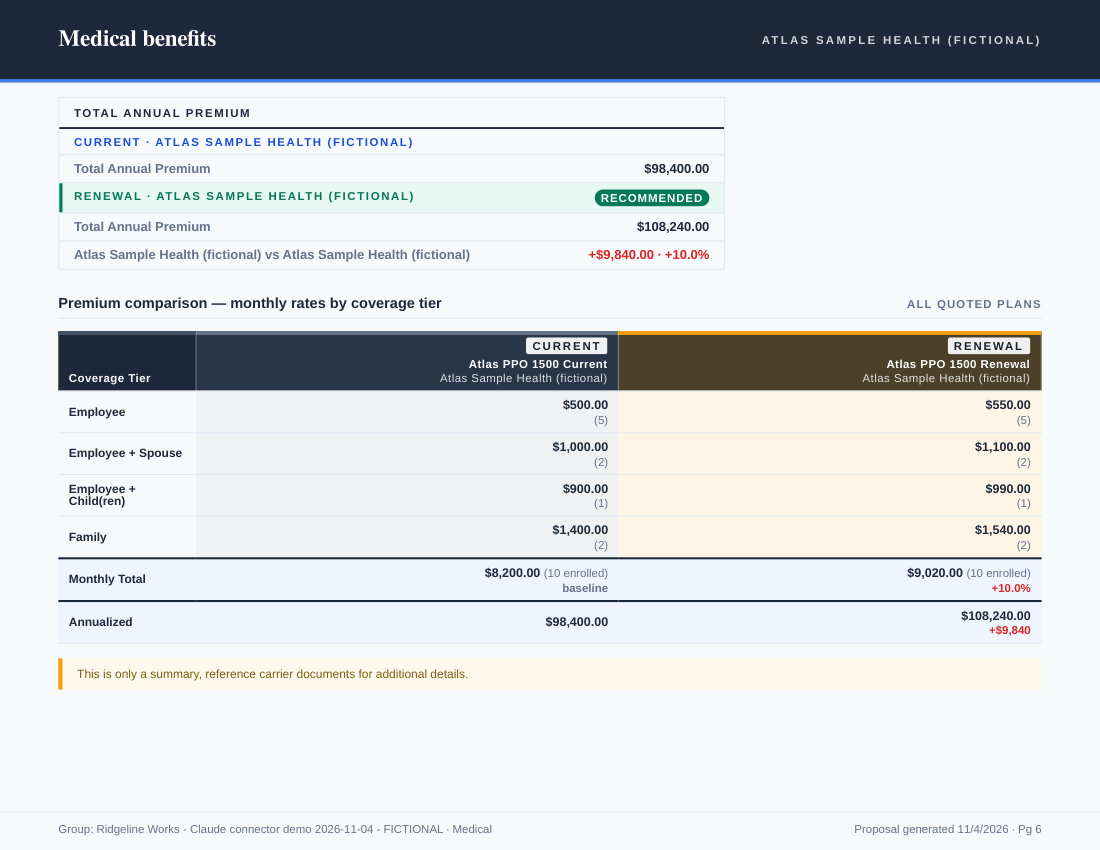
| Comparison and contribution arithmetic | Demonstrated | Current premium is $8,200 per month and $98,400 per year. Renewal is $9,020 per month and $108,240 per year. Both plans use 75% employer contributions, with enrollment held at 5 / 2 / 1 / 2. |
| Proposal PDF from Planlined | Demonstrated | The production application generated the downloadable seven-page PDF. Its comparison and financial totals match the checked case. The unchanged product download includes the source-review note on page 2. |
| Source qualifiers and plan dates | Incomplete | Coinsurance lost its after-deductible qualifier, and a manual AD edit did not survive case reload. Individual plan dates and source-page references were absent from read-back. The proposal note records the source qualifier and both coverage periods explicitly. |
| Review and delivery setup | Manual setup | The case was checked against the original PDF through the normal application UI. A review note was added and projection, payroll and closing pages were omitted. These checks were performed by an automated browser assistant acting on user instruction, not an independent broker or customer. |
Download the comparison and inputs
Direct downloads, no signup. The check record identifies the files and their SHA-256 hashes.
- Download the actual Claude-case proposal (PDF)
Unchanged seven-page product download. Page 2 records source review and unresolved field limitations.
- Download the fictional source packet (PDF)
The unchanged two-page input attached to Claude before the connector run.
- Download the check record and file hashes (JSON)
Expected and observed rates, enrollment, arithmetic, review work, export checks and boundaries.
Check the arithmetic against the source
With enrollment fixed at five employee-only, two spouse, one child and two family contracts, the current monthly premium is (5 × $500) + (2 × $1,000) + (1 × $900) + (2 × $1,400) = $8,200. Renewal is (5 × $550) + (2 × $1,100) + (1 × $990) + (2 × $1,540) = $9,020.
Multiplying by 12 gives $98,400 current and $108,240 renewal: a $9,840 annual increase, or 10%. With a 75% employer contribution, annual employer cost changes from $73,800 to $81,180; the combined employee share changes from $24,600 to $27,060.
These values appear in the actual exported proposal. Read page 2 alongside the benefit table: the financial check passed, while the coinsurance qualifier, per-plan dates and source references retain the limitations described above.
For the separate recorded 15-plan workflow, see the ChatGPT walkthrough. The assistant eligibility and setup guides explain the supported connection paths; this example demonstrates one Claude account.
How we verified the result
- Use the existing public, fictional two-page Ridgeline Works PDF unchanged. It contains two medical plans, eight monthly rates, enrollment by tier and a 75% employer contribution. No real customer or carrier data is involved.
- Attach the PDF to a new native Claude conversation. With the already-authorized Planlined connector enabled, request one new fictional case, full plan names, Current/Renewal roles and a read-back comparison. Do not modify existing cases or publish a client link.
- Open the saved case in the production Planlined application. Check the two plans, eight rates, enrollment and contribution totals against the source. Reload the saved case to distinguish displayed edits from values that persist.
- Retain the missing after-deductible qualifier, per-plan dates and source references as findings. A manual coinsurance edit displayed as 20% AD but reverted to 20% after reload. Add an explicit source-review page containing the qualifier, coverage periods and these limitations.
- Prepare the proposal in Planlined. Omit projection, payroll and closing pages whose assumptions are not supplied by the source, review the Export step and confirm the fictional demonstration scope. Generate the PDF through the application, without publishing a share link.
- Preserve the downloaded PDF bytes unchanged. Extract and independently check its rates and totals, then render and inspect all seven pages. The check record supplies source and output hashes and distinguishes the Claude transfer from subsequent review work.
What to review in your own case
- This is one synthetic two-plan workflow. It is not a customer outcome, an independent broker attestation, or an accuracy, speed or savings benchmark for Claude or Planlined.
- The source PDF was attached to Claude, not attached to the saved Planlined case. Automated source verification was not assessed; source-page references did not appear in the connector read-back.
- The original coinsurance is 20% after deductible. The saved case and benefit-detail table show 20%; the source-review note on page 2 preserves the omitted qualifier. A manual AD edit did not persist after reload. The check does not establish complete benefit-field fidelity.
- The source current period is October 1, 2025–September 30, 2026; renewal is October 1, 2026–September 30, 2027. The case holds the renewal policy period, while individual plan periods were not returned by the connector. Both original periods are listed in the review note.
- No proposed-plan record was created. The proposal carries the renewal option forward into its proposed-program financial path. Its $108,240 figure is the fictional renewal total, not a separately quoted alternative.
- Inline cover text edits visible in the preview did not appear in the downloaded PDF; the original fictional case title remains. The custom source-review page and section omissions did appear. The original product export is provided without presentation cleanup.
- Connector export tools were unavailable in this deployment. The PDF was generated in Planlined after review, not by Claude. This example does not demonstrate Microsoft Copilot, organization-wide setup, client sharing or an employee benefit guide.